• Aviso de importancia, Reglamento del Foro actualizado. Reglas Técnicas, punto Q. Ir al siguiente link: Ver aviso

La Segunda Guerra Mundial en Color

emilioteles

Colaborador
10629595_688401437956318_6317872095963300671_n.jpg


An American Medic and a GI of the US. 80th Infantry Division reading a comic at Reisdorf in Luxembourg near the German Border. 12th of February 1945

Left to right : Pfc Reynold H. Bush Middletown, Ohio , and Pfc Aurelio Maltese, New York

(Nb. On the 31st of May 1945, Pfc Aurelio Maltese, received the Bronze Star for Heroic Achievement during the 16th of February 1945)

In the US. Third Army's VIII Corps area, 4th Div completed the capture of Pruem.
Zone of 11th Armored Div. was extended southward as CCB relieved the 86th Cav. Rcn. Sq. of positions on the Nth flank of the 6th Armd Div. 41st Cav Rcn Sq., was detached from the 11th Armd Div and attached to the 6th Armd, closed at Knaphoscheid.
6th Cav Gp captured that part of Vianden (Luxembourg) W of the Our River. In XII Corps area, contact was made at Bollendorf between 80th and 5th Div bridgeheads and, within 80th Div zone, between those of 319th and 318th Regts. at E edge of Wallendorf. 319th Inf. finished its crossing of the Our River and continued reduction of stubbornly defended pillboxes on N flank of corps bridgehead; 318th improved positions S of Cruchten.
Tanks and TD's crossed into the 5th Div bridgehead, where 10th Inf. completed the capture of Bollendorf and continued N. In 76th Div zone, 3d Bn of 385th Inf. relieved the 1st Bn of the 417th in place and was attached to the 417th, which continued slowly E along N bank of the Sauer River. XX Corps maintained defensive positions. In 26th Div zone, 328th Inf began the relief of 104th on MLR.
 

emilioteles

Colaborador
11109498_688370601292735_55132236349571414_o.jpg

A Kriegsberichter (war correspondent) holding an Arriflex 35 2 1942 camera 35mm ACR 0292 and he is leaning against a knocked out Soviet BT-5 light tank. c.1940/1

Kriegsberichters were soldiers first and war correspondents second. They were expected to take part in assaults, offensive operations and fight next to their comrades as their positions were being overrun by the enemy rather than taking photographs. They gained respect very quickly as most Kriegsberichter demonstrated remarkable courage in the face of battle.
It is estimated that during the whole war the Kriegsberichters produced over 80.000 written reports and more than 2 million photographs.

The BT-5 tank entered service in 1933 and, with gradual deliveries until 1935, equipped all armoured cavalry brigades. The first active engagements came in Spain, in 1937.

During WW2, they were deployed in eastern Poland. They also soldiered during the "Winter War" in Finland, proving ill-adapted for the task with their thin armor. Losses were appalling. Finnish troops used Molotov cocktails as well and quickly found a weak point where the engine was installed, prone to catch fire and explode when hit, as shown in reports. In 1941 there were still hundreds of BT-5s in service despite the type having been replaced by the BT-7. But hundreds were lost or abandoned, worn out, during the summer offensive, liquidating what was left of the model. Only the lack of spare parts prevented the use of surviving vehicles until later in the war.
 

emilioteles

Colaborador
134367_687973087999153_4665560095425938140_o.jpg


Soviet Air Force officers, Rufina Gasheva (848 night combat missions) and Nataly Meklin (980 night combat missions) decorated as 'Heroes of the Soviet Union' for their service with the famed 'Night Witches' unit during World War II
They stand in front of their Polikarpov Po-2 biplanes.

The 'Night Witches' 588th Night Bomber Regiment flew harassment bombing and precision bombing missions against the German military from 1942 to the end of the war. At its largest size, it had 40 two-person crews. It flew over 23,000 sorties and is said to have dropped 3,000 tons of bombs. It was the most highly decorated female unit in the Soviet Air Force, each pilot having flown over 800 missions by the end of the war and twenty-three having been awarded the Hero of the Soviet Union title. Thirty of its members died in combat.
 

emilioteles

Colaborador
11102960_685756471554148_5737696523365883355_n.jpg


Focke Wulf FW-190A8/N 'Gelb' 20 (Yellow 20) of 3./Jagdgeschwader 54 (JG 54) on the airfield at Immola in Finland.
2nd of July 1944.

The JU-87 Stukas flying overhead are possibly from 1./Schlachtgeschwader 3 (SG 3)

The unit was part of the Detachment Kuhlmey which participated in large battles of summer 1944, during the Finnish-Soviet Continuation War. When the Soviet Red Army launched its fourth strategic offensive on the 9th of June 1944
C. G. E. Mannerheim asked Germany for help. Among the help that arrived was a Luftwaffe unit that arrived to Finland on the 12th of June. The aircraft landed at the Immola Airfield on the 17th of June. The unit used the whole airfield from there on. They flew some 2,700 missions against the enemy and dropped 770 tonnes of bombs on the enemy. It destroyed over 150 Soviet aircraft, about 200 tanks, dozens of bridges and transport vessels. 23 of the pilots died and 24 were wounded in battle. The unit lost 41 of its aircraft to all reasons.
The detachment consisted of some 70 airworthy aircraft to support the 200 strong Finnish force, but its operational strength varied due to losses, additions and troop movements. The unclear structure is partly explained by the Luftwaffe replacement programs, where obsolete Junkers Ju 87 "Stuka" dive bombers were replaced by Focke-Wulf Fw 190 jabo's (fighter-bombers).
 

emilioteles

Colaborador
11096400_685480241581771_6925352674086373072_n.png


A poor quality image, but we think 'Royston' managed to capture the drama by adding some colour.

Consolidated B-24 H Liberator, s/n 42-95379, 'Extra Joker' in the last photo taken of her on the 23rd of August 1944.
She belonged to the 725th Bombardment Squadron, 451st Bombardment Group. 15th US Air Force.

On that day, 'Extra Joker' took off with a flight of five other B-24s from Castellucio Airfield, Italy on a bombing mission against Markersdorf Airdrome, St. Polen, Austria. She was flying in the number two position.
According to T/Sgt. Lindley G. Miller, right waist gunner in the lead B-24, "She was hit by a FW-190 in the attack ....the main tanks burst into flame, after which the ship went into a spin to the left. After dropping approximately five thousand feet, the ship exploded". There were no parachutes seen leaving the plane as it went down near Turnitz, Austria at 11:16am.
No search for survivors could be made as the plane went down over enemy territory.

All ten crew were listed as MIA

1st Lt Kenneth A Whiting - pilot - Salt Lake City, Utah
1st Lt Alvin W Moore - copilot - McMinnville, Oregon
2nd Lt Francis J Bednarek - navigator - Ashley, Pennsylvania
2nd Lt Edward S Waneski - bombardier - Brooklyn, New York
Sgt Peter Breda - top turret gunner - Lima, Ohio
Sgt Harry V Bates - ball turret gunner - Reinholds, Pennsylvania
Sgt Joseph Garbacz - right waist gunner - Detroit, Michigan
S/Sgt Milton R Nitsch - left waist gunner - Sheboygan, Wisconsin
Sgt Elmer J Anderson - nose turret gunner - Los Angeles, California
Sgt Oscar W Bateman - tail turret gunner - Baton Rouge, Louisiana

(Photograph taken by Group photographer Sgt. Leo Stoutsenberger)
Stautsenberger had flown with the crew of the 'Extra Joker' as their cameraman, but on that fateful day they asked him to fly on another plane to take photo's of the 'Joker' in flight. Thanks to this coincidence Leo lived and made a series of shots of the loss of the aircraft. He said about this picture: "I felt guilty, helplessly snapping a picture while the men were burning inside. It happened so fast they didn't have much of a chance, I had photographed a picture of death, with the crew burning inside. It happened so quickly that they had little chance of surviving."
 

emilioteles

Colaborador
11102703_685419871587808_1291166565633010458_n.jpg

Mechanised units of possibly the Wehrmacht 26th Infantry Division rest over in the area of Staritsa, Kalinin Oblast, Russia.
21st of November 1941.

Vehicles - Sd.Kfz.252, Stug III Ausf C/D, Stoewer R200 W and a Morris Commercial

When the German advance continued toward Moscow, in October 1941, the division was sent to the region, attacking from the south side in Bjeloje, heading east, and then moved to the south side where he assisted the German units the Battle of Vyazma. After this battle, as in November, moved to North Staritsa Tyma between the Volga River and the west front of Kalinin (Tver).

With the arrival of the Russian winter, the 26th Division, like other German units, their advance had stalled, and retiring to the area of Rzhev, where in January 1942 faced heavy defensive fighting. The division had to fight and hold the front line between Bolkhov and Orel until the month of November.
 

emilioteles

Colaborador
10478355_682002235262905_1583311005723818872_n.jpg

ive Panzerkampfwagen V 'Panther' (Nr. 234 'Gerda' in the center) arrive at Pallières, a farm near Juaye-Mondaye, at about 15:30 on 10 June 1944. The unit was sent to support Pz.Aufkl.-Lehr-Abt. 130. The Panthers belong to the 2. Kompanie of I./Panzer-Regiment 6 from 3.Panzer-Division. The I./Panzer-Regiment 6 had recently been attached to Panzer-Lehr-Regiment 130 as the I. Bataillon of that unit. It would become I./Pz.-Lehr-Rgt. 130 at a later date.

A short timeline of events leading up to this event:

4 June – I./Pz.Rgt. 6 is loaded on trains to move east to Russia

5 June – First train of I./Pz.Rgt. 6 arrived in Magdeburg, Germany (the last train was still in Paris). It may be possible that these last 5 Panthers were never loaded onto a transport train.

6 June – Trains carrying I./Pz.Rgt. 6 ordered back to France

10 June – 5 Panthers of 2. Kompanie I./Pz.Rgt. 6 arrive at Juaye-Mondaye

15 June – Main body of I./Pz.Rgt. 6 arrives in the sector

Details of the five Panthers:

Nr. 234 'Gerda' – Panther Ausf. A
Nr. 2?? 'Christel' – Panther Ausf. A turret on an Ausf. D hull
Nr. 2?? 'Helsa' – Panther Ausf. A
Nr. 2?? – Panther Ausf. A

(Nb. the pic shows the muzzle of the 7.5 cm KwK 42 L/70 gun)

When the Allied invasion came, Panzer Lehr Division was one of the strongest divisions in the German Army, with 109 tanks, forty assault guns, and 612 half-track vehicles (double the normal Panzer div's component.)
The division was rushed to Normandy and thrown into the Battle of Caen, where it helped to halt Montgomery's advance, but at a terrible cost.
On the 25th of June it had only sixty-six tanks left, and by the 25th of July its combined tank/assault gun total stood at fifty.
Sent to oppose the American advance from St Lo, it was struck by 1,600 US. heavy and medium bombers on July 25th.
Two days later, the divisional commander reported Panzer Lehr as "finally annihilated".
 

fepago

Colaborador
11096400_685480241581771_6925352674086373072_n.png


A poor quality image, but we think 'Royston' managed to capture the drama by adding some colour.

Consolidated B-24 H Liberator, s/n 42-95379, 'Extra Joker' in the last photo taken of her on the 23rd of August 1944.
She belonged to the 725th Bombardment Squadron, 451st Bombardment Group. 15th US Air Force.

On that day, 'Extra Joker' took off with a flight of five other B-24s from Castellucio Airfield, Italy on a bombing mission against Markersdorf Airdrome, St. Polen, Austria. She was flying in the number two position.
According to T/Sgt. Lindley G. Miller, right waist gunner in the lead B-24, "She was hit by a FW-190 in the attack ....the main tanks burst into flame, after which the ship went into a spin to the left. After dropping approximately five thousand feet, the ship exploded". There were no parachutes seen leaving the plane as it went down near Turnitz, Austria at 11:16am.
No search for survivors could be made as the plane went down over enemy territory.

All ten crew were listed as MIA

1st Lt Kenneth A Whiting - pilot - Salt Lake City, Utah
1st Lt Alvin W Moore - copilot - McMinnville, Oregon
2nd Lt Francis J Bednarek - navigator - Ashley, Pennsylvania
2nd Lt Edward S Waneski - bombardier - Brooklyn, New York
Sgt Peter Breda - top turret gunner - Lima, Ohio
Sgt Harry V Bates - ball turret gunner - Reinholds, Pennsylvania
Sgt Joseph Garbacz - right waist gunner - Detroit, Michigan
S/Sgt Milton R Nitsch - left waist gunner - Sheboygan, Wisconsin
Sgt Elmer J Anderson - nose turret gunner - Los Angeles, California
Sgt Oscar W Bateman - tail turret gunner - Baton Rouge, Louisiana

(Photograph taken by Group photographer Sgt. Leo Stoutsenberger)
Stautsenberger had flown with the crew of the 'Extra Joker' as their cameraman, but on that fateful day they asked him to fly on another plane to take photo's of the 'Joker' in flight. Thanks to this coincidence Leo lived and made a series of shots of the loss of the aircraft. He said about this picture: "I felt guilty, helplessly snapping a picture while the men were burning inside. It happened so fast they didn't have much of a chance, I had photographed a picture of death, with the crew burning inside. It happened so quickly that they had little chance of surviving."
yo desconfiaría de cualquier toma de acción en color, la pelicla color en esa epoca era de muy baja sensibilidad, se necesitaba un dia muy soleado y exposiciones largas para obtener una foto.
 

emilioteles

Colaborador
11105156_688960874567041_3187620453294548416_n.jpg


US Air Force pilot 2nd Lieutenant Robert Wade Biesecker with his crew of the 569th Bombardment Squadron, 390th Bomb Group, US Eighth Air Force, standing by 'Honey Chile', their B-17 Flying Fortress bomber (serial 42-31027), at RAF Framlingham, a US Eighth Air Force Bomber Command station in England, 18 October 1943.

Posing with the group are mascots 'Scrappy' and Joe', a dog and a monkey. 'Scrappy" was presented to the crew while training in the US and accompanied the crew on their transatlantic flight to England. 'Joe' was picked up from another station, and the two animals become quite inseparable, 'Joe' regularly being carted around the base on 'Scrappy's back.

Robert 'Bob' Bisecker, a 24-year-old from North Carolina, had enlisted on 31 Mar 1942. Despite his young age, has was already married to 21 year-old Dorothy Rankin from Vancouver, and working as a sales agent.

On 18 May 1944, eight months to the day from when this photo was taken, Biesecker - now flying 'Rick-O-Shay III', another B-17 (serial 42-37925), of the 571st Bomber Squadron - was attacked by six ME 109 fighters while on a bombing run to Augsburg, Germany.

The aircraft exploded and crashed just south of Lahr near the Black Forest, Germany, after three of the crew had managed to bale out. Biesecker was killed in the engagement.

He is buried at the Lorraine American Cemetery, at St. Avold, France: grave 19, plot G row 5.

Dorothy remarried after his death and only passed away in May 2000, survived by one daughter, three grandchildren, a sister, a brother, an several nieces and nephews. I hope this post might find its way to some of them!
 

Shandor

Colaborador
Colaborador
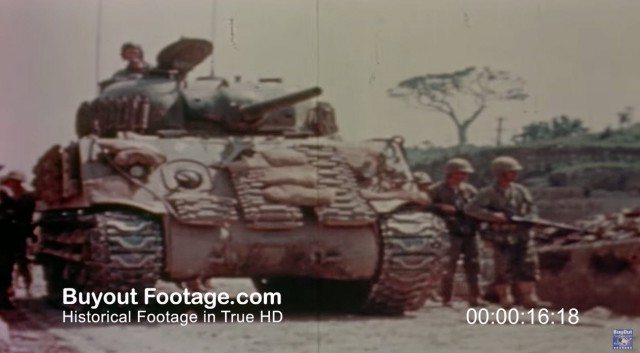
WWII COLOR Footage of the Battle of Okinawa


The Battle of Okinawa, codenamed Operation Iceberg, was fought on the Ryukyu Islands of Okinawa and included the largest amphibious assault in the Pacific War of World War II. The 82-day-long battle lasted from early April until mid-June 1945. After a long campaign of island hopping, the Allies were approaching Japan, and planned to use Okinawa, a large island only 340 mi (550 km) away from mainland Japan, as a base for air operations on the planned invasion of Japanese mainland (coded Operation Downfall).
Four divisions of the U.S. 10th Army (the 7th, 27th, 77th, and 96th) and two Marine Divisions (the 1st and 6th) fought on the island. Their invasion was supported by naval, amphibious, and tactical air forces
http://www.warhistoryonline.com/war-articles/wwii-color-footage-of-the-battle-of-okinawa.html
 
Arriba