At the end of 2nd Kish aka Persian Gulf Air show, Hossein Roustaie, manager of the office for design of Aeronautic and Space University said the constructions of Shafaq, a jet trainer capable of competing with other leading world jet trainers will soon begin with the capability to be converted to a jet fighter if there is any customer demand. He said this project in progress under Aeronautic/Space complex in cooperation with Malek Ashtar University will soon enters construction phase...
http://www.irna.ir/?SAB=OK&LANG=PE&PART=_NEWS&TYPE=HE&id=13831104194401
The fact that Iran continues to think long proves the project Shafagh, that with the conditions to that Malek Ashtar University OF Technology was presented. The sample, that as in and two-seaters to be built and also different engines both and training and and mehrzweckkampfflugzeug use to find is, points all characteristics of the modern building of combat aircraft up. Beside models of the different variants became also Wind tunnel model as well as photo of a Mockups shown. The parts manufacture for prototypes is to have already begun.
http://www.mig-21.de/Deutsch/Publikationen/FLiEGERREVUE0203.htm
"Shafagh" - the project of a future combat aircraft
A step into the future is the project "Shafagh", which was presented at the conditions of the Malek Ashtar University OF Technology. The sample, which as in and two-seaters are built and with different engines both when training as well as and mehrzweckkampfflugzeug use to find is, exhibits all characteristics of the modern building of combat aircraft. Beside models of the different variants also photos of a 1:1-Modells as well as a wind tunnel model were presented. According to statements of participants the parts manufacture for the prototype already began. All versions of the airplane are to be equipped - so the official statement - "with engines by the native market". Whether with it self-developments or license and/or reproductions of foreign engines are meant, was not verifiable.
http://www.mig-21.de/Deutsch/Publikationen/TRUPPENDIENST0103.htm
Shafagh has since been transferred to the MoD's Malek-e-Ashtar Industrial University, where it has undergone some changes including proposals for a chin-mounted air intake similar to that of the F-16 Fighting Falcon. There are now hopes of completing a flying example." (AFM December 2004, p37).
Iran unveils jet trainer
Following years of speculation, Iran unveiled its new advanced jet trainer on August 10. Named ‘Shafaq’ the aircraft is powered by a single engine. It is similar in configuration to the Yakolev Yak-130 trainer featuring a blended wing, but differs in being equipped with twin vertical tails. A single canopy encloses both cockpits, which are equipped with digital avionics and multifunctional displays (MFD). Wearing serial number 01 the trainer was recently displayed for the Islamic Republic of Iran Broadcasting (IRIB) and, according to the chief design engineer, it is currently undergoing flight tests.
Combat Aircraft Vol.6, No.3, pg 17.
November 2004
Iran Airshow 2002 - Iran's new combat aircraft waits in the wings
ROBERT HEWSON Editor, Jane's Air-Launched Weapons
Kish Island
Advanced design work has already been completed in Iran for an all-new advanced trainer and attack aircraft, known as the Shafagh ('the light before dawn').
The Shafagh design team, working under the aegis of the Aviation University Complex (AUC - part of the Malek Ashtar University of Technology), has conducted wind-tunnel tests of the design in Tehran using a 1/7-scale model, and has also built a full-scale mock-up of the aircraft.
The integration of landing gear and vehicle systems, such as hydraulics and avionics, is now under way, and the roll-out of the first prototype in scheduled for 2008.
The AUC team, based at Tehran's Mehrabad airport, is working to the instructions of the Iranian Revolutionary Guard Corps. Iranian industry sources say engineers from both the Russian Aircraft Corporation MiG (RSK MiG) and Sukhoi design bureaus have helped with the design. In the past, RSK MiG discussed licence-production of the MiG-29 (NATO reporting name: 'Fulcrum') fighter with Iran, but negotiations broke down irrevocably after both sides repeatedly failed to reach an agreement. Beyond this proposal, the real level of co-operation between the Iranian and Russian defence industries is unclear.
The Shafagh is a subsonic aircraft with an empty weight of around 5,000kg, an overall length of about 14m and a 12m wingspan. The aircraft has an ambitious aerodynamic configuration, with a close-coupled layout, substantial leading-edge root extensions and a highly unusual circular section at the wing root. The platform has been designed as an attack aircraft from the programme's outset, and is equipped with seven stores hardpoints - three beneath each wing and one beneath the aircraft's fuselage centreline.
The original design was built to have two J85 turbojet engines, but this has now changed to a single-engined configuration using a J79 power plant drawn from an F-4 Phantom strike aircraft. Preliminary designs for the cockpit layout show an aircraft equipped with three multi-function displays in a horizontal row, a head-up display and hands-on throttle and stick controls on a central column.
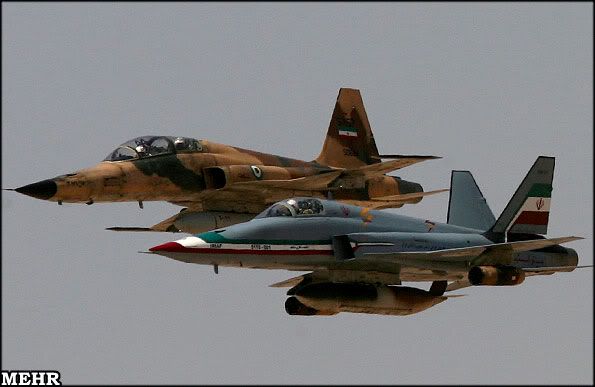
Mention has also been made of another combat aircraft project, the Saeghe, which is being developed by MATSA (Iran's air force technology and electronics centre), at Mehrabad. According to Iranian industry sources, the aircraft is a modified F-5 fighter that has been rebuilt in a twin-fin configuration.
Iran has already displayed considerable expertise in overhauling and adapting its inventory of F-5s. Work on constructing new fuselage sections under its air force programme to rebuild F-5As as F-5Bs is also understood to have been translated to the Saeghe. The programme's first airframe is reportedly about 70% complete and work on this is expected to be finished within the next six months. The relationship between the Saeghe and Iran's other reported F-5-derived combat aircraft programme - the Azarakhsh - is unclear.
Wind-Tunnel Testing
Iran's twin-seat Shafagh prototype nears completion
Flight International
15 Feb 2005
Iran's Malek-Ashtar University of Technology expects to conduct the first flight of its twin-seat Shafagh trainer late this year, with a first prototype nearing completion.
Also referred to as the M-AT/XXIC and exhibited in model form at last month's Iran air show on Kish Island, the Shafagh is believed to have last year completed mock-up inspection and windtunnel testing. Designed with assistance from Russian industry, the Iranian aircraft resembles Yakovlev's Yak-130 trainer, with large wing root extensions to enable high-angle-of-attack manoeuvres, but has a twin-fin vertical tail and a single engine.
Tehran-based Malek-Ashtar says an engine has already been selected, but declines to name the powerplant. Successful flight testing could lead the Iranian defence ministry to approve the Shafagh for series production, with combat trainer and light fighter variants also under consideration.
Provisionally referred to as the M-ATF, the latter version is viewed as a potential replacement for the Iranian air force's Northrop F-5E/F Tiger II fighters.
Inside Iran
…
Several companies and specialist universities form the focus of Iran’s aviation defense industries effort. The universities are tasked with proof of concept, development and early trials. Upon reaching their milestones, final trials and production are taken up by the aviation companies.
...
Iran Aviation Industries Organization announced at the airshow that it had reached the milestone of manufacturing all parts of the TF30 engines of the IRIAF’s F-14 Tomcats. According to the announcement by the project director, IAIO is now able to assemble entire TF30s from domestically-manufactured parts. Iranian engine specialists have around 30 years’ working experience with this powerplant. After all, they managed to keep the IRIAF’s F-14 fleet aloft through the Iran-Iraq War, despite US sanctions.
…
Furthermore, Iran has been spending a lot of time and energy on development of the Shafaq advanced jet trainer and M-ATF air superiority fighter, models of which were on display at Malek Ashtar University’s stand. The university is closely affiliated with Iran’s aerospace industry. Its head of aeronautic design said that the Shafaq was nearing the end of its design stage.
…
The single-engined, tandem two-seat aircraft resembles the Yak-130 from its nose to just aft of the wings’ trailing edges, but it has a twin-tail design similar to the defunct Polish “Skorpion” ground attack aircraft. The wing area is larger and the angle of sweep appears more pronounced than the Yak jet trainer, presenting the possibility of the aircraft being capable of sustained supersonic speeds of perhaps just over Mach 1. It has a one-piece cockpit canopy and the tandem cockpit does possess central control columns, contrary to previous reports. It is equipped with digital avionics and MFD, marking a major step forward in the technology employed by Iran’s aviation industries. The aircraft will undergo further modifications before it enters service with the IRIAF. A light interceptor/ground attack version with an uprated engine is on the cards to fill the gap created by the retirement of the IRIAF’s F-5E/F Tiger IIs.
The other model on display at the Malek Ashtar stand at Kish was of the M-ATF air superiority fighter. The Iranian press reported a while back that the design stage of a fighter designated Saeqe-80 had been completed, this supposedly being a scaled-up F-5F with Russian engines. However, many experts believe the whole thing may have been an elaborate hoax to keep under wraps the development of M-ATF or a similar design. What may substantiate this is that, several months ago, a photograph of a twin-tailed F-5E called Saeqe-2 was released in the West. It looked no larger than an F-5 and therefore unable to accommodate two Russian afterburning engines. The twin tail appeared ‘scabbed on’, so the aircraft may have indeed been a test bed. Should we draw a comparison between Saeqe-2’s twin tail and the proposed M-ATF’s, it therefore obvious that Saeqe-2 has been fitted with M-ATF’s tail configuration to perform high—speed flight trials hence, Saeqe-80 may be nearing completion. Furthermore, it may indeed be a revised version of the much anticipated Azarakhsh (Lightening) fighter design.
…
Combat Aircraft pg 28 May 2005