¿Qué sentido tiene? Pudiendo aumentar el número de sm-2Dado que para los Exocet se instalaron lanzadores adicionales a popa del puente... ¿eso quiere decir que se mantiene la capacidad de lanzar Harpoon desde el Mk-13?

Estás usando un navegador obsoleto. No se pueden mostrar estos u otros sitios web correctamente.
Se debe actualizar o usar un navegador alternativo.
Se debe actualizar o usar un navegador alternativo.
Noticias de la Armada de Chile
- Tema iniciado Nicanor_Chile
- Fecha de inicio
Serían hoy las mas poderosas unidades de la Escuadra?

¿En qué área? En AAW sí.Serían hoy las mas poderosas unidades de la Escuadra?
Y ahora en ASW? Mejor que con Harpoon (Las T-23)?¿En qué área? En AAW sí.

En potencia de fuego ASuW y AAW de largo alcance si.Serían hoy las mas poderosas unidades de la Escuadra?
Pero en ASW, potencia de procesamiento y capacidad anti-saturación, sin dudas, la Type-23 con PIDAA.
Queda por ver cómo queda la M, que ya tiene MM-40 Block III, con su upgrade de CMS a la turca y si cambian o no los RIM-7 por nuevos ESSM.
Para las Adelaide también deberían comprarse, no se han visto contratos de transferencia ni mantenimiento de ESSM.
Saludos
Y ahora en ASW? Mejor que con Harpoon (Las T-23)?
Harpoon es un misil de salida que esta siendo reemplazado en sus países usuarios.
Cuando llegue el momento de cambiarlos en las T-23 propondría uno con un sistema de guía diferente y pasiva como el NSM, sólo para introducir variabilidad e incertidumbre en un teórico adversario que tendrá que resolver un problema mayor de contramedidas ante uno o varios vampiros desde distintas direcciones no sabiendo si vienen guiados por radiofrecuencia, por IIR pasivo o por ambos (una salva combinada).
¿Es muy overkill lo que estoy planteando?
Saludos
Gracias. (Quise decir ASuW, no ASW)En potencia de fuego ASuW y AAW de largo alcance si.
Pero en ASW, potencia de procesamiento y capacidad anti-saturación, sin dudas, la Type-23 con PIDAA.
Queda por ver cómo queda la M, que ya tiene MM-40 Block III, con su upgrade de CMS a la turca y si cambian o no los RIM-7 por nuevos ESSM.
Para las Adelaide también deberían comprarse, no se han visto contratos de transferencia ni mantenimiento de ESSM.
Saludos
Se podrían pasar esos Harpoon a los F-16?Harpoon es un misil de salida que esta siendo reemplazado en sus países usuarios.
Cuando llegue el momento de cambiarlos en las T-23 propondría uno con un sistema de guía diferente y pasiva como el NSM, sólo para introducir variabilidad e incertidumbre en un teórico adversario que tendrá que resolver un problema mayor de contramedidas ante uno o varios vampiros desde distintas direcciones no sabiendo si vienen guiados por radiofrecuencia, por IIR pasivo o por ambos (una salva combinada).
¿Es muy overkill lo que estoy planteando?
Saludos
Se podrían pasar esos Harpoon a los F-16?
De acuerdo a las últimas noticias disponibles, se está trabajando en una versión del Harpoon que mitiga obsolescencia del seeker llamandose HIIU (Harpoon II update) que estaría trabajando la USN y que empezaría sus delivery en 2026.
Entre sus ensayos, se está probando una versión de lanzamiento aéreo.-
The latest Harpoon Block IIU is an iteration of the Harpoon Block II, which had previously incorporated an inertial system from high-precision JDAM bombs and guidance components and software from the SLAM-ER tactical missile.
The updated missile reportedly features ‘enhanced internal equipment’ to meet requirements for various system configurations and to support continued production. Specific details of the modifications and improvements were not disclosed.
The missile was tested from an F-15SA aircraft at the Naval Air Station Point Mugu. Boeing said the missile successfully met test objectives for propulsion, guidance, navigation, and control systems, while demonstrating the expected aerodynamic performance.
Delivery of the updated Harpoon Block IIU missiles is expected to begin in 2026.

Boeing Tests Upgraded Harpoon Anti-Ship Missile
The new Harpoon Block II Update (HIIU) has received modernization across nearly all systems to address obsolescence, as interest in the Harpoon continues to grow.
 militarnyi.com
Lamentablemente, no he visto que se puedan pasar municiones de lanzamiento de superficie a municiones de lanzamiento aéreo.
Tu inquietud coincide con la de la USAF:
U.S. Air Force Tests Harpoon Missile Integration on F-16
Published on: February 28, 2025 at 11:54 AM
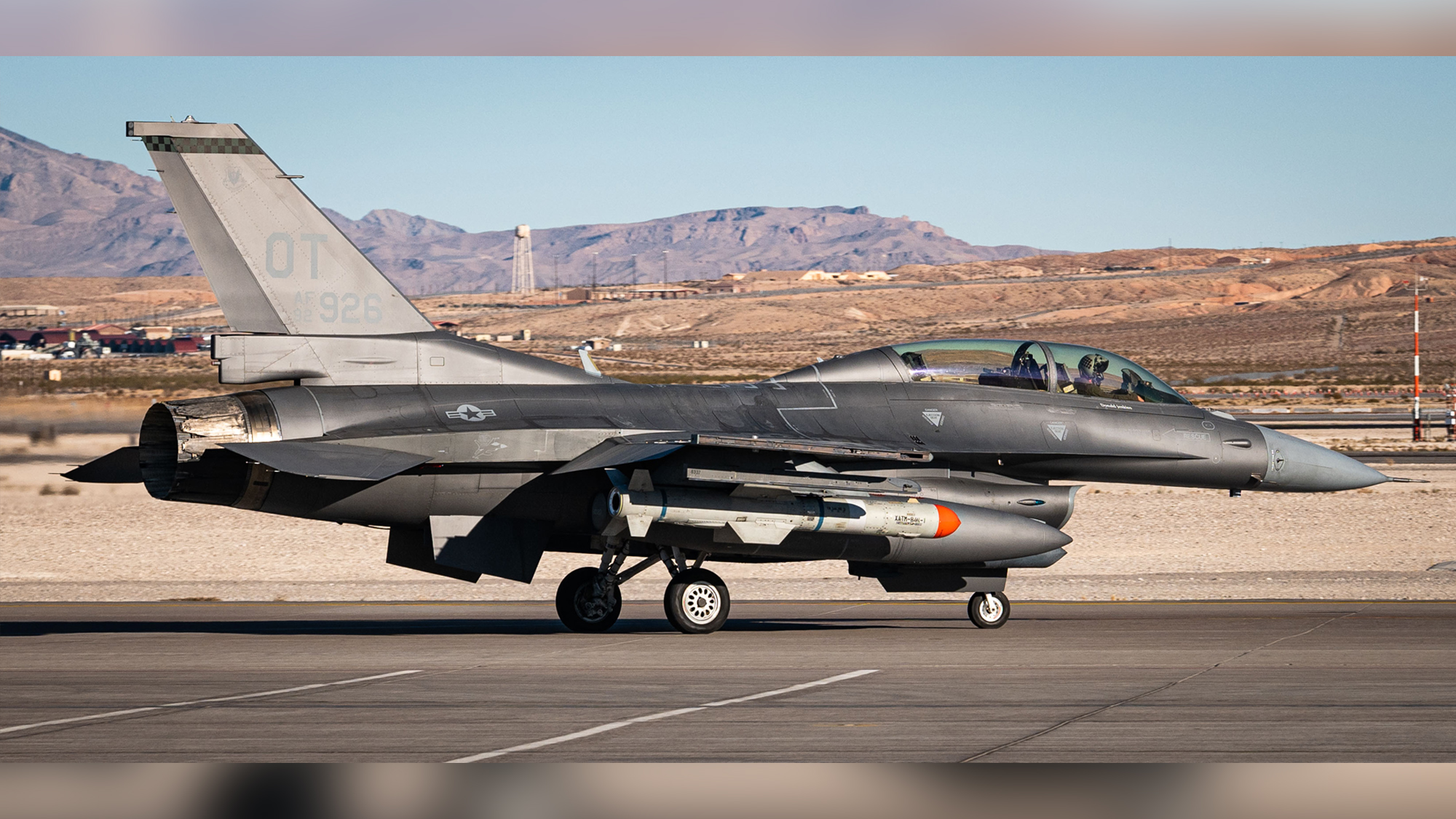
U.S. Air Force Tests Harpoon Missile Integration on F-16
The 53rd Test and Evaluation Group completed an operational taxi test with a U.S. Navy AGM-84N Harpoon Block II+ anti-ship missile loaded on a U.S. Air
 theaviationist.com
Saludos
Lo había conversado con "The Chief Project Manager for Rapid Integration" y pensábamos lo mismo. Aunque yo creía que era cosa de sacarle la "cachanfla" que va atrás (booster creo que le llaman) y "vualá". Pero parece que no basta con eso.Tu inquietud coincide con la de la USAF:
U.S. Air Force Tests Harpoon Missile Integration on F-16
The 53rd Test and Evaluation Group completed an operational taxi test with a U.S. Navy AGM-84N Harpoon Block II+ anti-ship missile loaded on a U.S. Air
Saludos
La otra , ir por F-15 no más po!

Unidades de la Armada de Chile: Al servicio de la Patria por mar, aire y tierra
Con un despliegue naval por las bahías de Concón, Viña del Mar y Valparaíso, la ciudadanía pudo presenciar el retorno de las unidades navales bajo el mando del Comando de Operaciones Navales, tras su entrenamiento anual en el sur del país.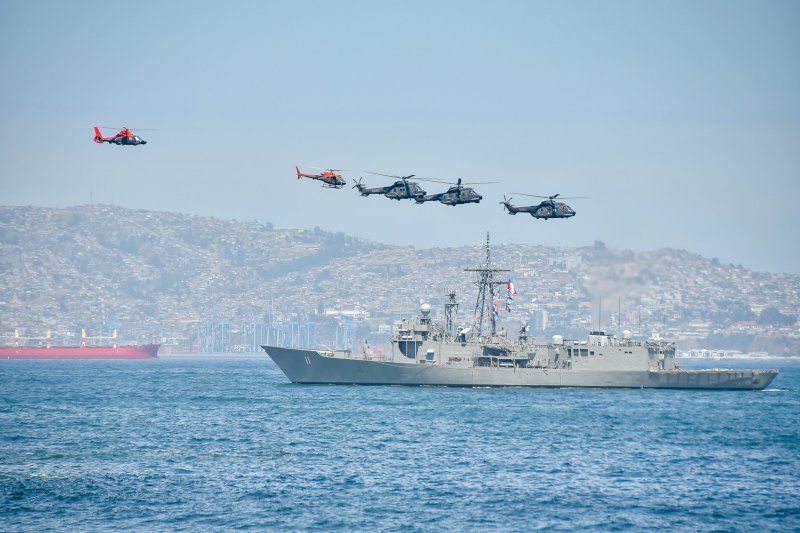
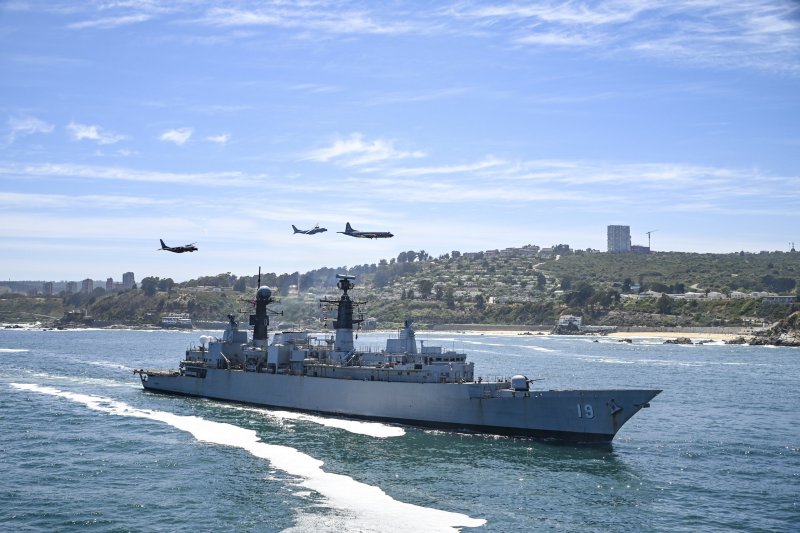
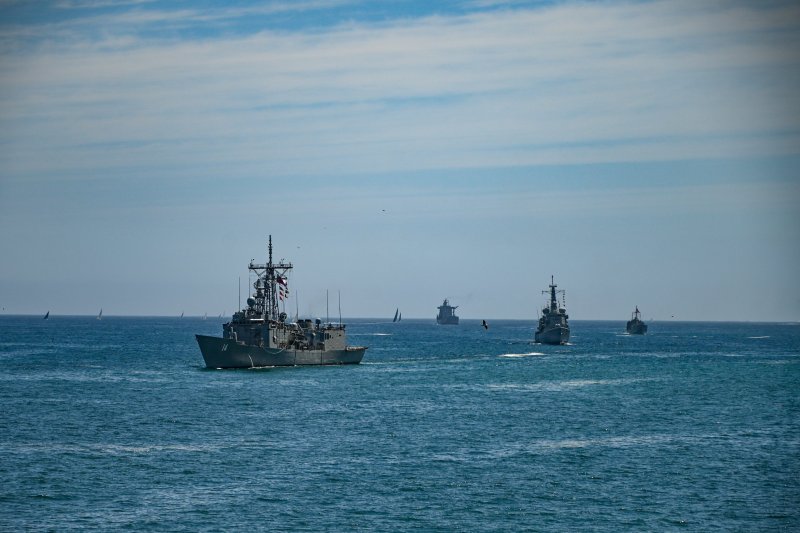
Un par de videos de la navegación costera del día de hoy.
Esperemos que mañana esté disponible el video completo.
https://www.youtube.com/shorts/hl8LgWpXQV8
https://www.youtube.com/shorts/MX5zIgpRb-w
La noticia en por T13:
Me pareció ver...
1/1 T-22
2/3 T23
2/2 Adelaide
1/2 M
1/2 P-3ACh
1/1 P-295MP
1/2 P-295ASW
2/5 AS-332F1
1/4 AS-332L
Saludos

September 3, 2025
News Commentaries
Royal Navy’s Type 31 frigate on course for export success in Scandinavia
The FT reports the UK is in advanced negotiations to build new warships for Denmark and Sweden. Having just won an order for 5 Type 26 frigates for Norway, this would be a remarkable turnaround in UK warship exports with great benefits to the RN and the wider British economy.
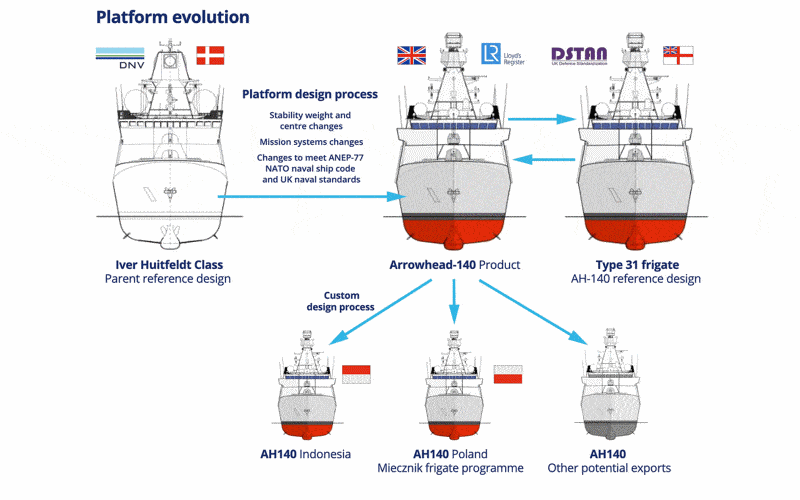
The discussions centre on Babcock’s Type 31 frigate, based on the Arrowhead 140 design, which has already been selected by Indonesia and Poland. In both cases, local construction was favoured, but the Danish and Swedish deals are expected to include substantial work at Babcock’s Rosyth shipyard in Scotland.
Type 31 full circle
Denmark seems likely to place an order for 3 Type 31 derivatives to be constructed in the UK, possibly with further ships of the class to be subsequently built in Denmark.The Royal Navy’s Type 31 frigate is derived from the Arrowhead 140 design, itself based on the Danish Iver Huitfeldt class. The three Iver Huitfeldt air-defence frigates entered service with the Royal Danish Navy in 2012–13 and were built around the modular StanFlex system, which allowed rapid changes to weapons configurations. While outwardly similar, the Arrowhead 140 represents a significant redesign, dispensing with the StanFlex approach and incorporating major improvements in survivability over the original Danish ships. The Iver Huitfeldts were block-built in Estonia and Lithuania, with sections transported to the Odense Steel Shipyard in Denmark for final assembly and weapon integration.
The Huitfeldts were conceived as modular air-defence ships with the StanFlex system allowing rapid changes to weapons fits. While cost-effective, the class has suffered from long-running integration issues with its APAR radar and combat management system. The problems became starkly apparent when HDMS Iver Huitfeldt deployed to the Red Sea in 2024, with limitations in combat system integration undermining effectiveness against missile threats. The Danish defence ministry has since concluded that mid-life upgrades are uneconomical and the ships will be reduced in capability to second-line patrol duties.
The new Danish frigates, though based on the Arrowhead 140, are expected to be tailored primarily for air defence, with different sensors and weapons compared with the general-purpose vessels under construction for the RN. They are likely to have greater resemblance to the Polish Miecznik class being built in Poland in partnership with Babcock, another ambitious adaptation of the design.
Type 31 v FDI for Sweden
Talks with Sweden are described as positive but more complex. Stockholm is considering buying frigates to complement its corvette programme and has a choice between Type 31 or the French FDI frigate, supported by a recently signed Franco-Swedish defence cooperation agreement. The Swedish requirement is for up to four frigates, with a decision expected by the end of the year.Babcock is already working with Saab on the development of Sweden’s new Luleå-class corvette. A joint venture signed in 2024 sees Saab provide the baseline design while Babcock contributes engineering and systems integration expertise. It is possible that the Luleå-class could be constructed in Rosyth and subsequently fitted out in Sweden.
Further building on this partnership an Arrowhead-140 / Type 31-based frigate for Sweden could be a logical choice. This competition is potentially more challenging. Unlike Norway’s recent anti-submarine warfare frigate selection, where the high-end Type 26 was chosen over the lower-end French FDI frigate, the Swedish requirement is seen as more closely matched to what the FDI can offer. Winning the contract will depend as much on industrial and political alignment as on ship design.

Wider significance
These developments come as the UK seeks to deepen defence ties with Scandinavian partners to counter Russia’s submarine and missile threats in the High North. Operating similar platforms will not only strengthen NATO’s northern flank but also create opportunities for common training, logistics and operational cooperation across allied fleets.Babcock has already begun delivering five Type 31 frigates for the RN, with the first-of-class HMS Venturer due to enter service later this decade. With deals in Indonesia and Poland already secured, likely construction for Denmark and Sweden a possibility, this would cement the Type 31’s place as one of the most successful European warship exports of the decade. Chief Executive of Babcock Marine, Sir Nick Hine, told Navy Lookout in May this year that he has set the target for his exports team for “31 by 31”. This aspiration to have around 31 Type 31/Arrowhead 140 derivatives built or on order worldwide by 2031 does not seem too far-fetched, with Chile and New Zealand also rumoured to be interested in Type 31.
The UK was once the shipbuilding powerhouse of the world, and even after the major decline following the Second World War managed to successfully export warships up until the 1990s, when it started to lose out to European yards, many of which were at least partially subsidised by the state. A decade ago, the idea that the UK could bounce back so spectacularly seemed highly unlikely. Despite the much-trumpeted UK Shipbuilding Strategy published in 2017, the recent export successes have really been down to other factors. Russian aggression in Ukraine and President Trump’s hesitance to back NATO is driving a re-armament across Europe that was unforeseen, even in 2017.
Although developed in a painfully slow and drawn-out gestation, the Type 26 design represents arguably the finest submarine-hunting surface combatant in the world. Its competitors may be cheaper and have better all-round capabilities, but it is the best in the specialist role and builds on decades of RN ASW expertise and the excellence of the Type 23s.
The RN’s decision in 2015 to build a simpler, cheaper frigate (GPFF) with a fixed price of £250M that led to Type 31 has proved wise. Although the initial delivery timeframe was wildly optimistic and the cost envelope has been somewhat exceeded, the RN is getting affordable and adaptable ships in a relatively quick time. Babcock’s decision to go for a large adaptable platform as the basis for their bid has also paid off. Although financially they will barely break even on the RN programme, in the long run the investment will pay off handsomely if a continuous drumbeat of production can be maintained at Rosyth.
The Type 32 (or Type 31 batch II) frigate programme promised by Boris Johnson’s government seems to be an unfulfilled promise, given constrained budgets. This means subsequent work at Rosyth on export projects will not involve quite the same trade-offs in delivery for the RN that the Type 26 frigates for Norway imply. However, the RN will benefit by being part of a large community of Arrowhead-140 operators with all economies of scale and opportunities for shared support, expertise and interoperability that comes with international collaboration.
Royal Navy’s Type 31 frigate on course for export success in Scandinavia - Navy Lookout
The FT reports the UK is in advanced negotiations to build new warships for Denmark and Sweden. Having just won an order for 5 Type 26 frigates for Norway, this would be a remarkable turnaround in UK warship exports with great benefits to the RN and the wider British economy. The discussions...
 www.navylookout.com
Cada vez mas feos los buques que están haciendo. Hasta los predreadnought franceses se verían mas bonitos en comparación!!
Habrá que esperar que resulta de esos concursos y ver si realmente es conveniente para chile ese buque.
Entiendo que ese buque tiene propulsión Diesel, sin embargo puede tener modificaciones en ese aspecto, a pesar que los buques de esa serie hasta el momento son todos codad.
Entiendo que ese buque tiene propulsión Diesel, sin embargo puede tener modificaciones en ese aspecto, a pesar que los buques de esa serie hasta el momento son todos codad.
Chile, con mayúscula por favor.Habrá que esperar que resulta de esos concursos y ver si realmente es conveniente para chile ese buque.
Entiendo que ese buque tiene propulsión Diesel, sin embargo puede tener modificaciones en ese aspecto, a pesar que los buques de esa serie hasta el momento son todos codad.

Eduardo Moretti
Colaborador

Con un imponente desfile naval, la Armada de Chile culmina con éxito su Ciclo Operativo 2025
Con un imponente desfile naval frente a las costas de Concón, Viña del Mar y Valparaíso, la Armada de Chile cerró uno de sus periodos de entrenamiento más
 www.zona-militar.com
Eduardo Moretti
Colaborador
Si hay foto, hay video
No era video... solo una animación de fotos.
Si hay foto, hay video
Temas similares

- Respuestas
- 1
- Visitas
- 231
- Respuestas
- 17
- Visitas
- 2K