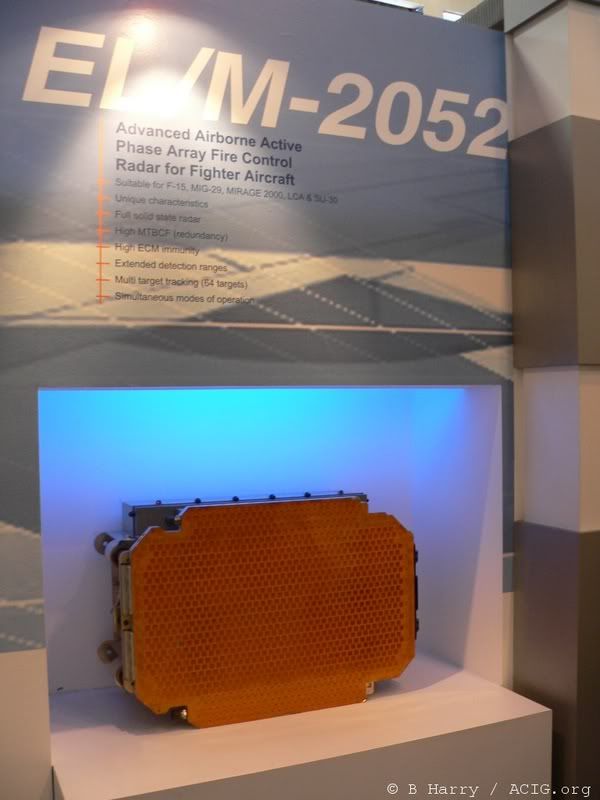
Elta EL/M-2052
Israel’s Elta Systems Ltd. is planning a maiden flight test of its new EL/M 2052 active phased-array fire control radar, which is aimed at the international fighter aircraft upgrade market.
The multimode radar, unveiled publicly at the Aero India exhibition in Bangalore earlier this year, synthesizes synthetic aperture radar (SAR) and phased-array radar capabilities developed for larger reconnaissance platforms or pods into a single system small enough to be packed in the nose of fighter jets.
Based on solid-state active electronically scanned array (AESA) radar technology, the EL/M 2052 is designed to operate in air-to-air, precision ground strike and air-to-sea modes at the same time, with each mode optimized to find and track multiple targets with exceedingly high resolution. According to specifications released by the company, the radar will weigh 130 to 180 kilograms (286 to 396 pounds) and operate on four to 10 kilovolt amperes of power, depending on antenna size.
In the air-to-air role, the radar is designed to detect, track and target multiple aircraft, unmanned aerial vehicles or low-flying targets such as helicopters. At sea, the radar is designed to search, classify and track targets, while also performing maritime patrol and surveillance functions. And, in the air-to-ground role, the radar exploits SAR technology to sort through clutter and other terrain-obscuring elements to identify and track ground objects on the move, according to company marketing data.
“This radar introduces new dimensions to air superiority and advanced strike missions. It’s a real breakthrough because of all the different types of targets and missions that can be handled at the same time,” Elta President Israel Livnat told C4ISR Journal.
In an early March interview, Livnat said Elta had invested a significant amount of independent research and development funds on technologies incorporated in the new radar. The company is now testing the system on the ground and subsequently will test it on a Boeing 737.
“We’ve done a lot of ground tests and field checks, and will soon begin flying the radar in our 737 test bed. At the same time, we’re examining a derivative of this X-band technology for different types of ground applications,” Livnat said.