





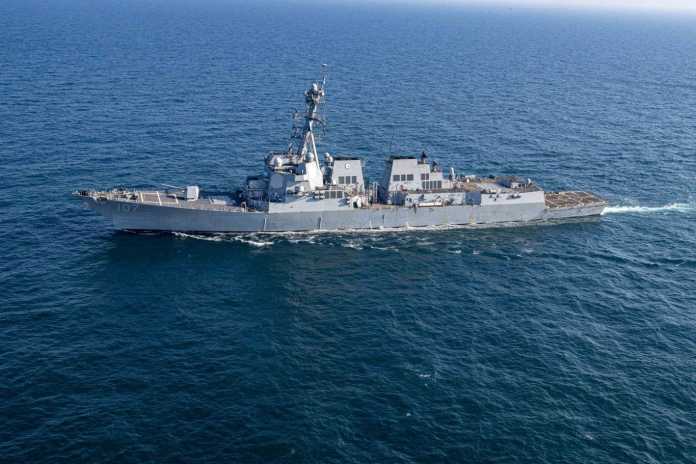
In the framework of the maritime security operations promoted by the United States in the region, three destroyers of the U.S. Navy will be deployed off the coast of Venezuela with the objective of reinforcing the fight against drug trafficking. In this context, the U.S. Navy assigned the Arleigh Burke-class destroyers USS Gravely (DDG-107), USS Jason Dunham (DDG-109), and USS Sampson (DDG-102), all equipped with the Aegis combat system.
The USS Gravely and the Jason Dunham sailed from Mayport last week, while the Sampson is near the Panama Canal. In addition, the Littoral Combat Ship USS Minneapolis-St. Paul (LCS-21) is already operating near Curaçao, while the Iwo Jima Amphibious Ready Group (ARG) remains in Norfolk awaiting favorable weather conditions after the passage of a hurricane.

Alongside the surface assets, the deployment includes air units and an unidentified Los Angeles-class attack submarine, whose exact location was not specified for operational security reasons. In total, it is estimated that about 4,000 U.S. Navy and Marine Corps personnel will participate in these operations, which will extend over several months in international waters of the Caribbean.
The employment of this naval and air force is not only aimed at surveillance and interdiction tasks, but would also allow, if necessary, the execution of precision operations against specific targets. The combination of Aegis destroyers, P-8 Poseidon aircraft, and a nuclear attack submarine provides Washington with a comprehensive deterrent capability against the maritime routes used by drug cartels and, at the same time, a demonstration of naval power in the region.
From Caracas, President Nicolás Maduro reacted harshly, assuring that Venezuela “will defend its seas, its skies, and its lands” against what he described as “the extravagant, bizarre, and outlandish threat of a decaying empire.” Although the Ministry of Communication did not issue an official statement on the arrival of the ships, Maduro’s speech made clear his government’s rejection of the intensification of the U.S. military presence in the Caribbean.
This deployment is not an isolated event. In 2020, amid strong political tensions with Caracas, Southern Command led one of the largest naval operations in the Caribbean in decades, mobilizing destroyers, logistical support ships, and patrol aircraft. Similar actions have been repeated since then, forming a pattern of operations that combines the fight against transnational organized crime with the projection of U.S. naval power in its strategic sphere of influence.

With the arrival of the three destroyers, the support of air and submarine assets, Washington seeks to intensify pressure on criminal organizations designated as global terrorists, among them the Sinaloa Cartel and the Venezuelan group Tren de Aragua. The operation falls within the U.S. administration’s strategy of reinforcing border security and curbing illicit flows into North America, in a scenario that increases both diplomatic and military tension in the Caribbean.
*Images used for illustrative purposes
You may also like: Amid tensions between Guyana and Venezuela, U.S. cruisers and destroyers conducted exercises with the navies of the United Kingdom and the Netherlands in the Caribbean

